
About Ginger Labs
The expert AI agent inside the product.
Ginger Labs builds domain-expert AI agents that live inside B2B SaaS products. Instead of sending users to a separate chatbot, the agent works in the side panel, inline, or modal where the workflow already happens.
The product is designed for complex, multi-step work across construction tech, legal tech, CRM and sales, fintech, HR tech, DevTools, healthcare, and EdTech. Its MCP-as-a-service layer also lets users bring product work into the AI tools they already use.
Product principles
SEO context
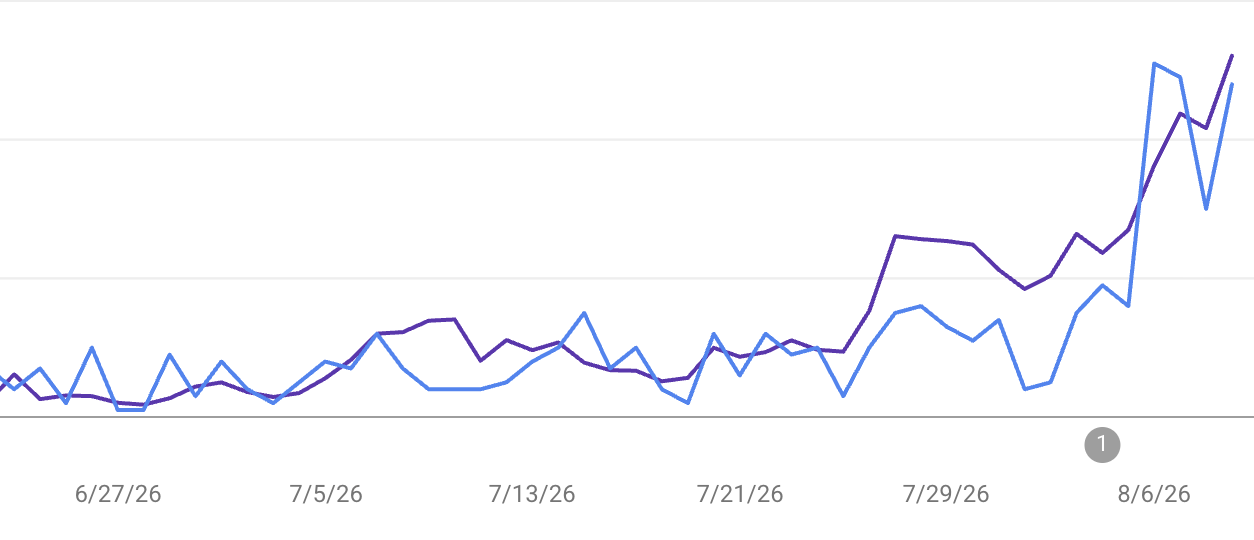
The Ginger Labs engagement turned a fragmented technical category into a focused organic-search program. From the Aug 4 “1” integration marker to the current chart endpoint, daily impressions grew 120% and daily clicks grew 153%.
1. The challenge
Make a frontier category understandable and findable.
A complex product category
Ginger Labs sits at the intersection of embedded agents, MCP, model routing, inference, and production AI infrastructure. The category is valuable, but its search language is fragmented across technical decisions rather than one obvious product term.
High-intent queries demand technical depth
Questions such as vLLM versus Ollama, RouteLLM versus semantic routers, and GGUF versus AWQ versus GPTQ are decision moments. Winning them requires clear trade-offs, implementation detail, and a point of view that engineers can trust.
Organic discovery had to compound
Ginger Labs needed traditional organic search to connect technical questions with product relevance. The content system had to earn qualified clicks across fragmented AI-infrastructure decisions.
2. The strategy
Build an evidence-led production-AI knowledge layer.
01
Own the decision moments
Build around the comparisons and implementation questions already appearing in Search Console, including MCP transports, model routing, quantization, serving frameworks, and prompt caching.
02
Create a production-AI topic system
Connect individual technical guides into a coherent knowledge layer spanning model selection, inference, routing, cost, latency, and embedded-agent workflows.
03
Write for qualified clicks
Use direct answers, decision frameworks, clear entities, and evidence-led explanations so pages are useful to engineers and strong enough to earn a click.
Search-to-visibility loop
From technical questions to qualified search visibility.
The operating model connects the language engineers use, the explanations they need, and the search surfaces where those answers are discovered.
01
Search demand
Find the technical comparisons and implementation questions that signal an active buying or build decision.
02
Technical clarity
Turn each question into a precise explanation with trade-offs, benchmarks, and a clear recommendation path.
03
Topic depth
Link related guides into a durable production-AI knowledge layer rather than a collection of isolated posts.
04
Search visibility
Measure web clicks and impressions, then use the signal to choose the next topic and sharpen the next brief.
3. Execution: the RocketAEO model
How we achieved this
We operate as an embedded growth and intelligence team, connecting technical understanding, content production, and search measurement into one continuous system.
01
Query mining and topic selection
Search Console data surfaces the language engineers already use, from model comparisons to serving and routing decisions. Those signals become the editorial roadmap.
02
Technical briefs and content production
Each brief is organized around the decision a reader needs to make, with definitions, constraints, comparisons, and a practical framework for choosing a path.
03
Search observability
We track organic-search performance so the team can see which explanations are being discovered, clicked, and carried into the next editorial decision.
04
Iteration around the winners
Pages that earn traction become hubs for the next set of related questions, creating compounding topical coverage instead of one-off traffic spikes.